エピソード

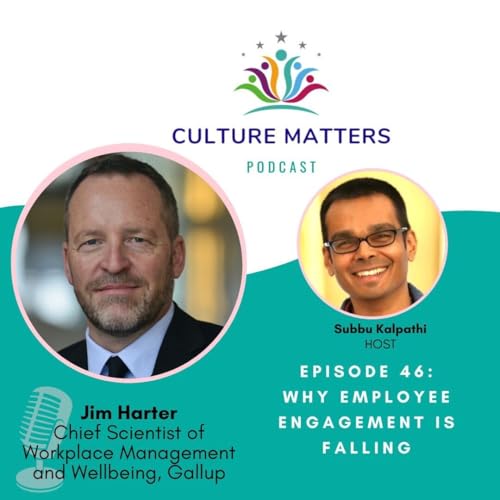
  • Why Employee Engagement is Falling with Jim Harter
    2026/05/26

    Jim Harter is Chief Scientist for Workplace Management and Wellbeing at Gallup and one of the world’s leading researchers on employee engagement, wellbeing, and organizational performance.


    For decades, Jim has studied how people experience work—what helps them thrive, what drives performance, and why some organizations consistently create stronger cultures than others. His work has shaped global conversations around engagement, strengths, leadership, and the future of management, and the annual State of the Global Workplace report has become one of the most widely referenced studies on the modern workplace.


    In this episode, Jim returns to Culture Matters to unpack the findings from the 2026 report and what they reveal about the current state of work globally.


    We explore:

    • Why employee engagement has now declined for the second consecutive year
    • The growing pressure and emotional burden managers and leaders are carrying
    • What organizations with highly engaged managers are doing differently
    • Why AI adoption is ultimately a management and leadership challenge
    • The tension between productivity gains and rising fear around AI-driven job loss
    • How leadership and management roles may need to fundamentally evolve
    • The relationship between engagement, wellbeing, burnout, and performance
    • And why this moment may represent a genuine inflection point in the future of work
    続きを読む 一部表示
    44 分
  • The legacy of Chanakya and Sun Tzu with R Gopalakrishnan and Nirmala Isaac
    2026/05/05

    R. Gopalakrishnan (Gopal) is one of India’s most respected business leaders, having held senior roles at Unilever and the Tata Group. Over the years, he has also become a thoughtful voice on leadership, learning, and life through his writing and speaking. Nirmala Isaac is a doctoral scholar whose work spans organizational behavior, leadership, and sustainability, with a deep interest in trust and institutional dynamics.


    In this episode, Gopal, Nirmala, and Subbu explore the deep and fascinating relationship between India and China through the lens of history, culture, and exchange. Drawing from their book, the guests bring together the ideas of Chanakya and Sun Tzu to uncover how civilizations evolve, interact, and learn from one another over time.


    We cover:

    • The origin story behind the book and the collaboration
    • The idea of “travel, trade, and thought” as the foundations of civilizational exchange
    • How business offers a unique, practical lens to build relationships across borders
    • The similarities and differences between Chanakya and Sun Tzu
    • What ancient dynasties like the Mauryas and the Han can teach us about leadership and stability
    • Stories of cultural exchange that still echo today, from language to rituals
    • Why relationships, whether between people or nations, evolve by focusing on shared interests
    • And what modern leaders can learn from history about navigating complexity and difference
    続きを読む 一部表示
    29 分
  • The Leader As Facilitator with Vinay Kumar
    2026/04/22

    Vinay Kumar is a leadership facilitator and organizational development expert who has spent close to two decades helping leaders and organizations navigate complex conversations, build alignment, and strengthen culture. He’s the Founder Director of C2C OD and has been the global chair of the International Association of Facilitators (IAF).


    In this episode, Vinay and Subbu explore facilitation not just as a skill, but as a fundamental shift in how leadership shows up today. In a world where knowledge is abundant and easily accessible, the role of the leader is evolving, from being the one with answers to the one who creates the conditions for better answers to emerge.


    We cover:

    • What facilitation really means and why it’s often misunderstood
    • Why facilitation is becoming an essential leadership capability
    • How leaders can move from giving answers to asking better questions
    • The role of facilitation in building alignment and driving cultural change
    • Why culture is the “spine” of an organization and what happens when it’s unstable
    • Common mistakes facilitators and leaders make when working with groups
    • The importance of creating spaces where all voices are heard
    • And why leadership, ultimately, is a practice, not a theory, and never a finished product
    続きを読む 一部表示
    27 分
  • Uncovering the Rookie Playbook with Pawan Kumar Marella
    2026/04/08

    Pawan Kumar Marella is a global business leader whose career spans sales, marketing, strategy, and general management across India, Africa, and the UK. From starting out in sales at Unilever—despite training in engineering and finance—to setting up business operations in Ethiopia and later working in corporate strategy in London, Pawan’s journey reflects both range and reinvention.


    He is also the author of Dear Rookie, Don’t Panic—a candid, practical guide to navigating the realities of corporate life. Drawing from two decades of experience, the book distills what most professionals learn the hard way: how to deal with uncertainty, manage relationships, build credibility, and grow through setbacks.


    In this episode, Pawan and Subbu explore the often-unspoken side of early careers—the panic, the pressure, and the steep shift from campus to corporate life. They unpack what it really takes to succeed at work: skill, but adaptability, self-awareness, and the ability to work effectively with others.

    We cover:

    • Why the transition from competition to collaboration is harder than most expect
    • The four non-negotiables for long-term success: health, integrity, trust, and showing up
    • What personal branding really means—and why it’s more than self-promotion
    • How to navigate teams, conflict, and corporate culture with practical tools
    • The idea of “trust but verify” and how to build reliability without micromanaging
    • Why performance is the true currency of corporate life
    • The importance of visibility and documenting your work in today’s environment
    • And how the energy you bring—being a radiator or a vacuum cleaner—shapes the culture around you


    続きを読む 一部表示
    45 分
  • Engagement, Well-being and the Future of Work with Jim Harter
    2025/10/30

    Jim Harter is Chief Scientist of Workplace Management and Well-being at Gallup — one of the world’s most trusted voices in understanding what makes work, and workers, thrive. Over three decades at Gallup, Jim has helped shape how organizations across the globe make sense of engagement, performance, and well-being.


    His research has defined the modern science of engagement. From pioneering the first meta-analysis linking engagement to performance outcomes, to co-authoring Wellbeing at Work with Jim Clifton, Jim’s work has influenced leaders, managers, and policymakers in every industry.


    In this episode, Jim and Subbu explore the evolving story of how people feel about their work: what drives engagement, why well-being can’t be separated from it, and how today’s hybrid workplaces are testing the limits of both. They unpack Gallup’s latest State of the Global Workplace 2025 report — from the sharp decline in manager engagement to the paradox of remote work, where autonomy rises but connection fades.


    We cover:

    • How Gallup’s decades of research have reshaped our understanding of work
    • The drop in global engagement and why it matters more than most leaders think
    • Why managers hold 70% of the variance in engagement and what to do about it
    • The three habits of great managers
    • How engagement and well-being intertwine, and why one without the other won’t last
    • The rise of “the great detachment” and what it says about loyalty and belonging
    • How AI and hybrid work are redefining the manager’s role
    • The next frontier in Gallup’s research: strengths utilization and how it drives both performance and prosperity
    続きを読む 一部表示
    47 分
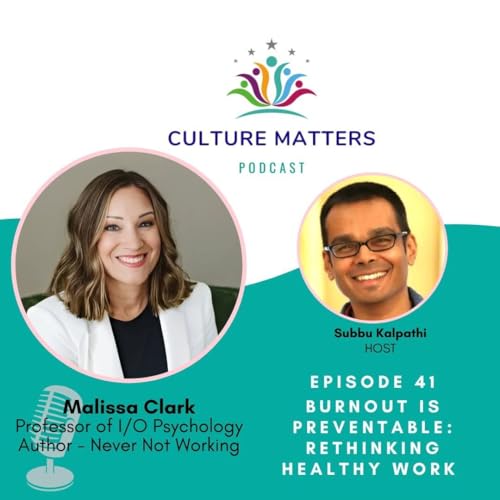
  • Burnout is preventable: Rethinking healthy work with Malissa Clark
    2025/09/24

    Professor Malissa Clark is one of the world’s leading scholars on workaholism, burnout, and the science of healthy work. She is Professor and Head of Psychology Department at the University of Georgia, where she also leads the Healthy Work Lab. Her research has redefined how we think about overwork as a multidimensional phenomenon with deep consequences for individuals, families, and organizations.


    Prof. Clark is the author of Never Not Working, a book that blends rigorous research with personal insight to challenge the myths of productivity and the culture of “always on.”


    In this episode, Malissa and Subbu unpack why workaholism is far more complex than simply clocking long hours, how burnout is preventable, and what both individuals and organizations can do to build healthier ways of working. They also explore the hidden costs of overwork on families, the myths that refuse to die, and the cultural signals that silently enforce “ideal worker” norms.


    We cover:

    • Malissa’s winding career path—from sales and consulting to academia
    • Why she founded the Healthy Work Lab and what “healthy work” really means
    • The four dimensions of workaholism: motivational, cognitive, emotional, and behavioral
    • Why long hours don’t predict productivity—and how overwork can harm teams
    • The health consequences of chronic overwork—from poor sleep to cardiovascular risk
    • The ripple effects of workaholism on spouses, children, and workplace culture
    • Burnout as an organizational problem, not just an individual one—and why it’s preventable
    • Practical strategies to “kick the habit”: Eisenhower matrix, recovery breaks, and mastery experiences
    • How organizational norms—like praising late-night availability—shape unhealthy cultures
    • What leaders can do to reset expectations, model balance, and experiment with change
    • The promise and challenges of the four-day week movement
    • Why vulnerability and personal storytelling matter in academic work
    続きを読む 一部表示
    53 分
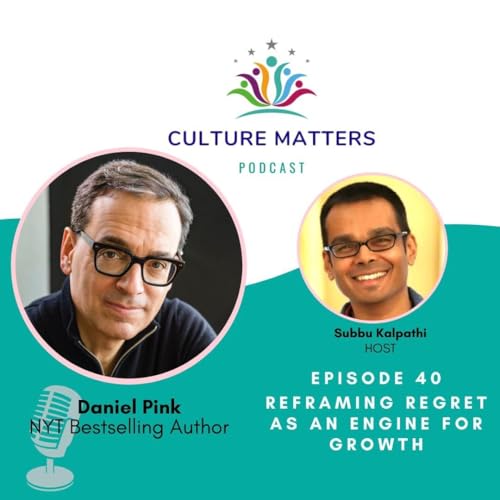
  • Reframing Regret as an Engine for Growth with Daniel Pink
    2025/09/03

    Daniel Pink is one of the world’s most influential thinkers on work, behavior, and human motivation. He is the author of seven New York Times bestsellers—including Drive, When, and The Power of Regret—books that have shaped how leaders, educators, and individuals approach purpose, timing, decision-making, and the emotions that drive us.


    Across a career that spans law, politics, speechwriting, and two decades of groundbreaking writing, Dan has made complex research in psychology and behavioral science accessible to millions of readers worldwide. His TED talks have been viewed tens of millions of times, and his work continues to influence the way organizations and individuals think about performance, choice, and meaning.


    In this episode, Dan and Subbu unpack why regret is not something to suppress but a vital emotion that helps us learn, grow, and make better choices. They also explore how to navigate today’s flood of information, the habits of good decision-making, and the human commonalities revealed by studying regrets from around the world.


    We cover:

    • Dan’s winding career path—from law school and politics to bestselling author
    • Why he regrets not having mentors early in his career
    • How he stays current with fast-moving research without drowning in information
    • The puzzle at the heart of The Power of Regret—why an emotion that feels terrible is so universal
    • Why “no regrets” culture is misguided, and how to confront regrets productively
    • The difference between regrets of action and inaction—and why inaction regrets dominate as we age
    • The four universal categories of regret: foundation, boldness, moral, and connection
    • What 26,000 submissions to the World Regret Survey reveal about being human
    • How to deal with regrets through self-compassion, writing, and sense-making
    • The regret optimization framework, and how to apply it to the decisions that matter most
    • Why kindness and pro-social behavior should become our “default setting”
    • How changing the delivery of ideas matters as much as the ideas themselves in an age of AI and distraction
    続きを読む 一部表示
    43 分
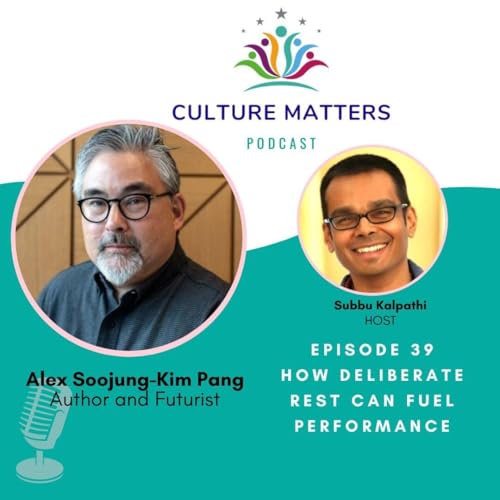
  • How deliberate rest can fuel performance with Alex Soojung-Kim Pang
    2025/08/13

    Alex Soojung-Kim Pang is a historian, futurist, and one of the most compelling voices rethinking the way we work, rest, and create. He is the author of Rest, Shorter, and The Distraction Addiction—books that have reshaped the global conversation on productivity and wellbeing.


    Alex has worked across academia, tech, publishing, and firms like the 4 Day Week Gobal. Today, he leads programs with 4.dk - a Dutch team leading 4-day week experiments in Denmark, and 4 Day Week studio.


    In this episode, Alex and Subbu explore the science and art of deliberate rest, why overwork is counterproductive, and how the four-day week is moving from radical idea to mainstream practice. The conversation draws on history, neuroscience, and real-world experiments to reveal how we can all work better by working less.


    We cover:

    • Alex’s unconventional “Grand Theft Auto” career path—from historian to tech futurist to rest evangelist
    • The mentors and moments that shaped his thinking
    • Why overwork persists—and how it erodes creativity, judgment, and empathy
    • What it really takes to rest well: active recovery, multiple time scales, and deliberate planning
    • The “four-hour rule” of deep work and how great minds from Darwin to Hemingway structured their days
    • The link between morning routines, the default mode network, and creativity
    • The concept of deep play and why serious hobbies sustain high performance
    • The business case for the four-day week, and what early adopters have learned
    • How AI is changing the way we discover and apply research
    • What the music industry can teach us about creativity and collaboration in the age of automation
    続きを読む 一部表示
    1 時間 3 分